 Free & Pro
Traditional cycling analytics rely almost exclusively on a single number: Functional Threshold Power (FTP). While FTP provides a broad baseline for steady-state aerobic endurance, real cycling is rarely steady. Road races, criteriums, gravel climbs, and group rides are characterized by repeated anaerobic surges above threshold followed by intermittent recovery periods.
To give cyclists a true real-time picture of their remaining high-intensity capacity, SuperCycle incorporates Dr. Charles Dauwe's Extended Critical Power (ECP) model. This system calculates your Anaerobic Reserve (W'bal)—a dynamic, second-by-second "battery gauge" showing how much high-intensity energy you have left before exhaustion, and how quickly your body recharges when you ease off the pedals.
1. The Two-Engine Concept: Aerobic Horsepower vs. Anaerobic Battery
Human exercise physiology relies on two fundamentally different energy systems working in tandem:
- The Aerobic Engine (Critical Power, CP): Powered by oxygen, fatty acids, and carbohydrates. As long as you stay at or below your Critical Power, your aerobic system produces energy sustainably with minimal fatigue byproduct accumulation.
- The Anaerobic Battery (W', measured in Joules): When you attack on a steep hill or bridge a gap, your wattage exceeds your aerobic ceiling. Your muscles immediately tap into a finite reserve of anaerobic work capacity (adenosine triphosphate, phosphocreatine, and anaerobic glycolysis). This "battery" typically holds between 10,000 and 30,000 Joules (10–30 kJ) of work. Once this battery hits 0%, you experience total neuromuscular exhaustion and cannot sustain high wattage until you recover.
2. The Four Physiological Thresholds in the ECP Model
Unlike simplistic two-parameter models that assume recovery is instantaneous and linear, Dr. Dauwe's ECP framework identifies four critical physiological thresholds across your power-duration curve:
- Critical Power (CP / Maximal Aerobic Power): The asymptotic upper limit of sustainable aerobic work (Watts). Below CP, fatigue accumulates very slowly; above CP, anaerobic work is mandatory.
- Anaerobic Capacity (W', in Joules): The total energetic capacity of your anaerobic battery before depletion.
- Recovery Threshold (RT): The exact wattage below which anaerobic replenishment actually begins. Crucially, Dr. Dauwe demonstrated that you do not recover simply by pedaling below CP—lactate shuttle mechanisms and PCr resynthesis require pedaling below a lower, distinct Recovery Threshold (typically 80% to 90% of CP).
- SuperCritical Power (SCP): The threshold separating sustainable supra-threshold work from severe, rapid anaerobic depletion. It marks the boundary between the Slow Death and Fast Death zones.
The 7 ECP Metabolic Training Zones
Derived from the ECP mathematical fit, SuperCycle segments your power into 7 physiological zones:
- Zone 1 (General Recovery): 0 to 0.60 × RT (Active circulatory recovery).
- Zone 2 (FatMax): 0.60 to 0.75 × RT (Peak fat oxidation, base aerobic building).
- Zone 3 (CarbMax): 0.75 × RT to RT (High aerobic tempo, glycogen utilization).
- Zone 4 (Slow Death, SD): RT to SCP (Supra-threshold, gradual anaerobic accumulation).
- Zone 5 (VO2max): SCP to P5min (Maximal aerobic uptake, rapid fatigue).
- Zone 6 (High Anaerobic): P5min to P1min (Severe anaerobic capacity depletion).
- Zone 7 (Explosive): Greater than P1min (Neuromuscular sprint power).
3. The Bioenergetic Mathematics: Depletion & Replenishment
During every second of your ride (Δt), SuperCycle updates your Anaerobic Reserve according to your instantaneous power (P):
A. Dynamic Depletion (Surging Above Threshold)
When you push past your thresholds, your anaerobic tank drains in one of two modes:
- Fast Death Zone (P > SCP): At high intensities, the rate of anaerobic drain is proportional to the difference between your current power and Critical Power:
ΔW'depletion = (P − CP) · Δt
- Slow Death Zone (RT < P < SCP): In this intermediate zone, fatigue accumulates gradually at a rate determined by the supra-threshold slope:
ΔW'depletion = (P − RT) · SlopeSD · P · Δt
B. Dynamic Exponential Replenishment (Recovering Below RT)
When your effort drops below your Recovery Threshold (P < RT), the dynamic replenishment algorithm calculates recovery using an adaptive time constant (τ).
The time constant τ as used by EXREC and SuperCycle is paramount to the realistic computation of your anaerobic balance. Other cycling platforms often model recovery using a single fixed value of τ (the so-called mono-exponential recovery) or a bi-exponential recovery. Both approaches are unsuitable for second-to-second calculations because they do not consider your current state of exhaustion, nor do they allow for individual adaptations.
SuperCycle implements Dr. Dauwe's proprietary multi-exponential recovery model, which dynamically computes τ at every instant and includes an Individual Recovery Index (IRI) adaptable across all ages, genders, intrinsic talent, and current state of fitness or training:
- Depth of Recovery Matters: If you are pedaling only slightly below your Recovery Threshold, τ remains large, meaning replenishment occurs gradually. If you coast or soft-pedal downhill (P ≈ 0), recovery kinetics accelerate toward their optimal rate, recharging your battery as quickly as your physiology permits.
- Current Battery Level Matters: Replenishment rate continuously responds to your current depth of exhaustion, reflecting biological creatine phosphate (PCr) resynthesis kinetics.
- Individual Recovery Index (IRI): A personalized multiplier that tailors dynamic recovery kinetics to your individual physiological profile.
C. Physiological Load Indices & % VO2max Dynamics
To quantify cardiovascular and metabolic strain over the ride, SuperCycle computes three distinct cumulative load metrics and real-time oxygen kinetics:
- Aerobic Load Index: A normalized score where 1.0 equals exactly 1 hour of continuous cycling at the Recovery Threshold (RT). It measures sustained base endurance accumulation and the time window during which anaerobic recovery was biologically possible.
- Slow Death Load: Measures cumulative supra-threshold strain between RT and SCP. A value of 1.0 indicates having drained the equivalent of your entire Anaerobic Reserve (W') once in this zone.
- Fast Death Load: Quantifies severe supra-SCP exhaustion. The index indicates the number of times your entire Anaerobic Reserve was drained during attacks, steep ramps, and all-out sprints.
- Live % VO2max Tracking: Below Supercritical Power (SCP), the % VO2max widget displays a smoothed running average of the oxygen uptake demanded by your current wattage. At SCP, oxygen uptake reaches 100% and caps, as all supplementary work above SCP is generated through anaerobic pathways.
4. Profile Calibration: Peak Power Milestones
SuperCycle fits your personalized ECP curve using five reference durations from your ride history:
| Reference Point | Duration | Physiological Role |
|---|---|---|
| P1 | 2 minutes (120 s) | Peak anaerobic capacity & neuromuscular power |
| P2 | 5 minutes (300 s) | Maximal aerobic capacity (VO2max power) |
| P3 | 10 minutes (600 s) | Supra-threshold endurance benchmark |
| P4 | 20 minutes (1,200 s) | Classic sustained threshold effort |
| P5 | 40 minutes (2,400 s) | Aerobic steady-state stamina (estimated as 0.95 × P4 if unrecorded) |
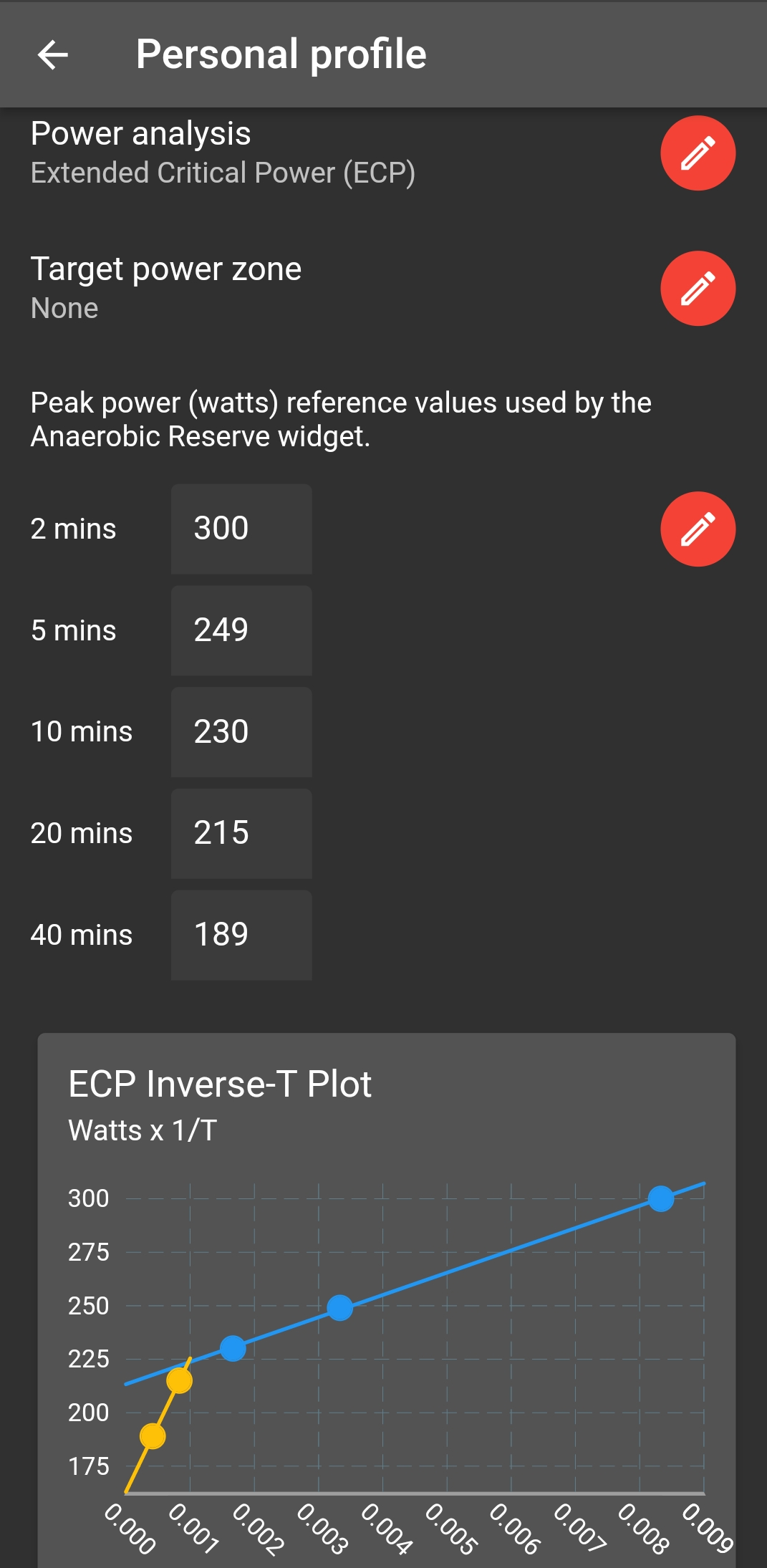
Under Settings → Sensors → Power Meter → Anaerobic Reserve Reference Values, four management tools are provided:
- From history: Automatically scans your ride database to extract your best power milestones across the 5 reference intervals.
- Enter manually: Input known values from laboratory testing or recent field tests.
- Save: Snapshot your current reference set (e.g., peak summer racing form).
- Load: Restore any previously saved calibration snapshot.
Seasonal Retraining Note: Because the automatic history scanner searches for historical peaks, your reference values may remain calibrated to peak summer fitness after an off-season or period of lower training volume. If you find your battery draining too rapidly during base training, enter current values manually or use Load to revert to an earlier baseline.
Whenever you finish a strong ride with new personal records, SuperCycle automatically detects your improved milestones and prompts you to update your Anaerobic Reserve reference values.
5. Why Physical Power Meters Are Mandatory
Cyclists frequently ask: "Can SuperCycle calculate my Anaerobic Reserve using speed, GPS slope, and estimated power if I don't own a power meter?"
The answer is strictly no. Anaerobic Reserve calculations require the high-frequency precision of a direct-force power meter or smart trainer. Physics-based power estimation cannot be used for this calculation for fundamental physical reasons:
- The Wind Blindspot: Speed sensors and GPS only measure ground speed, not airspeed. If you are grinding into a 15 mph (24 km/h) headwind, you may be pushing 350 Watts—well into your Fast Death zone—while your ground speed is only 13 mph. Estimated power would calculate an easy 120 Watts and falsely show your anaerobic battery recharging when in reality it is seconds away from complete depletion!
- Drafting in Pelotons: Sitting behind another rider cuts aerodynamic drag by 25% to 40%+. A direct power meter measures your true lower power, while estimated power assumes you are in full wind alone, causing the algorithm to falsely drain your battery to 0%.
- Instantaneous Torque Spikes: Anaerobic efforts are characterized by explosive, violent micro-surges (out-of-the-saddle attacks, punchy kickers, sprint jumps). Strain gauges on pedals or cranks measure instantaneous torque changes within milliseconds. Speed-derived models inherently lag and smooth out these peaks, missing the true anaerobic cost.
- Dangerous Pacing Guidance: If an app gave pacing advice based on estimated anaerobic capacity, a cyclist in a headwind could be led to believe they have ample reserve, push past their limit, and completely blow up far before the summit or finish line.
6. Pacing Tactics: Using the W'bal Gauge on the Road
SuperCycle provides both numeric widgets (remaining Joules and percentage from 0% to 100%) and a real-time color-coded dial gauge for your ride screen:
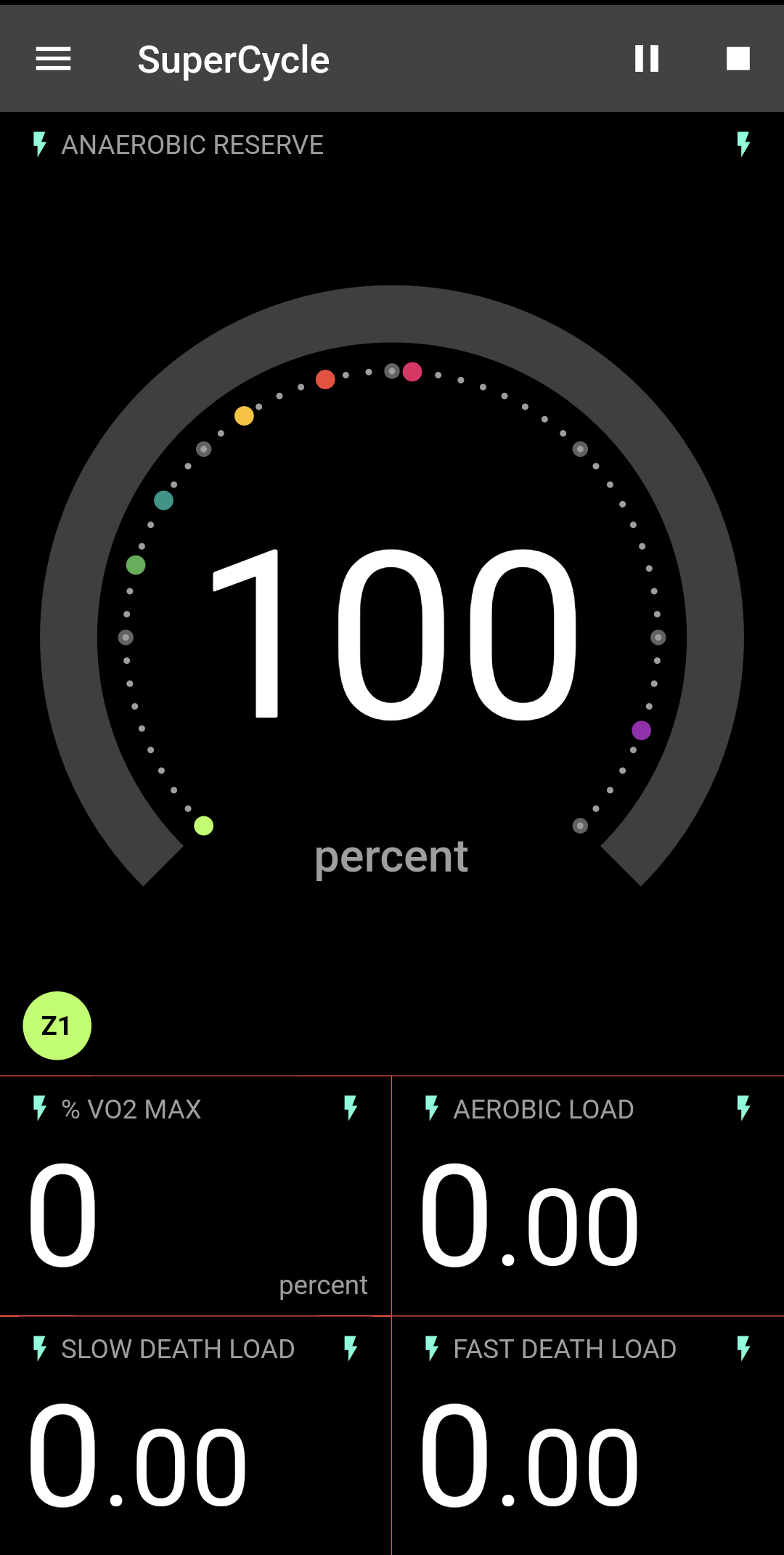
The dial gauge shows your remaining high-intensity capacity from 100% down to 0%:
- Green (80%–100%): Battery fully primed. Ideal time to launch attacks or tackle steep pitches aggressively.
- Yellow (40%–80%): Moderate depletion. Maintain a controlled pace; reserve remaining watts for crucial obstacles.
- Orange (15%–40%): Deep fatigue. Dial back immediately to below your Recovery Threshold (RT) on descents or flats to trigger exponential recharge.
- Red (0%–15%): Imminent exhaustion. Total failure occurs at 0%. Drop wattage below RT immediately to avoid blown legs.
Negative Percentages ("Super Legs"): On exceptional days when you are performing above your historical curve, your Anaerobic Reserve may occasionally dip slightly below 0% into negative territory. If you observe negative values repeatedly on strong rides, it indicates your fitness has improved and your reference power records should be updated.
7. Post-Ride Telemetry Analysis: Power vs. W'bal Curves
Following any ride recorded with a power meter, you can inspect the second-by-second interaction between work rate and anaerobic battery depletion. Open History, select your ride, and switch to the Power tab:
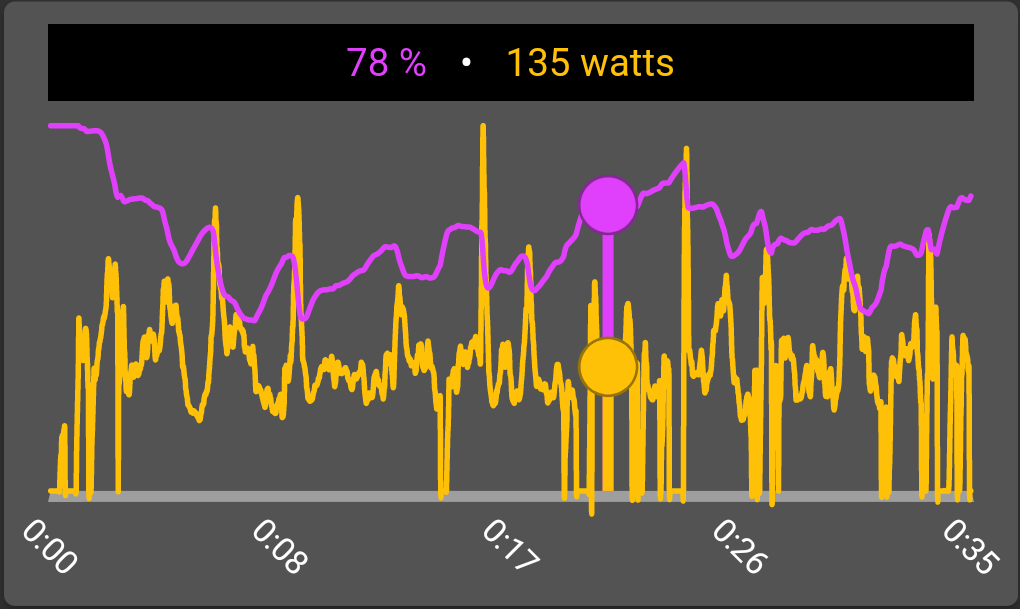
The yellow curve displays delivered wattage, while the purple curve tracks your fluctuating Anaerobic Reserve. In competitive road races and punchy group rides, the purple curve vividly illustrates each surge, the depth of anaerobic deficit, and how quickly your exponential recovery kicked in during coasting and descending.